
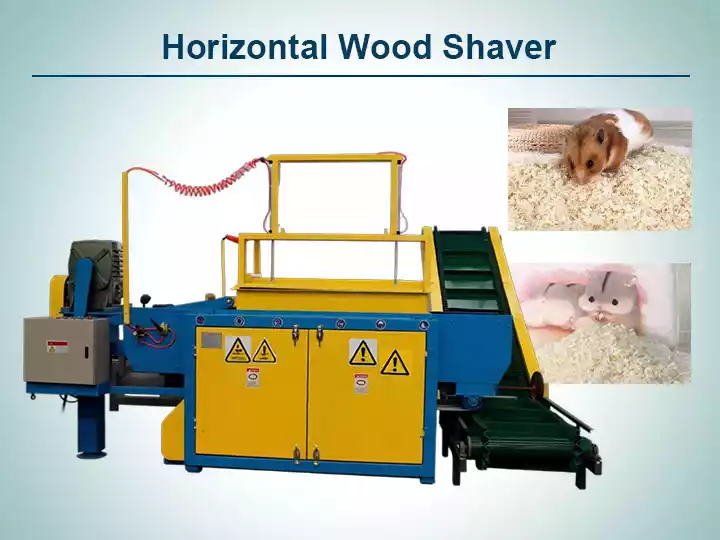
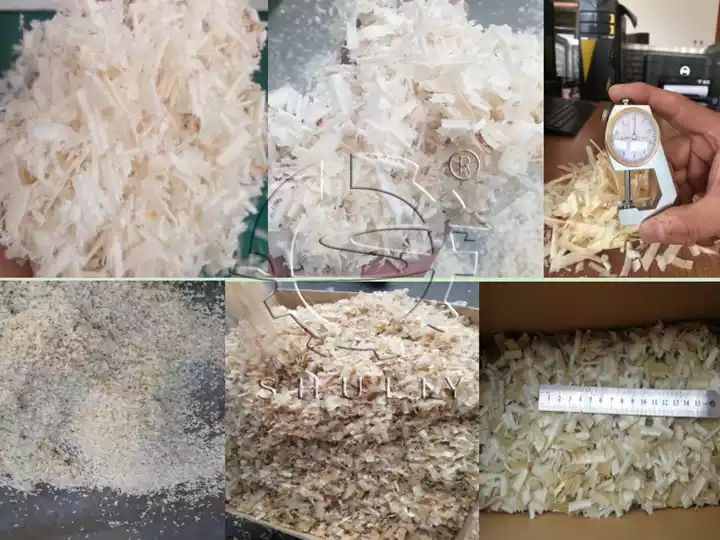
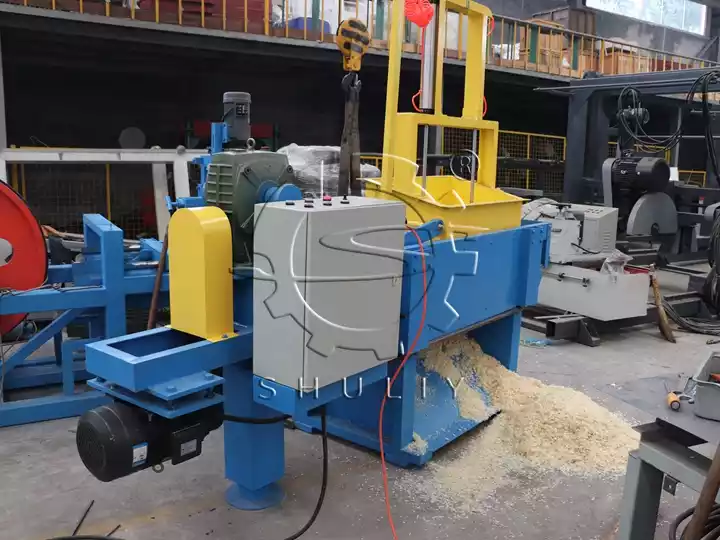
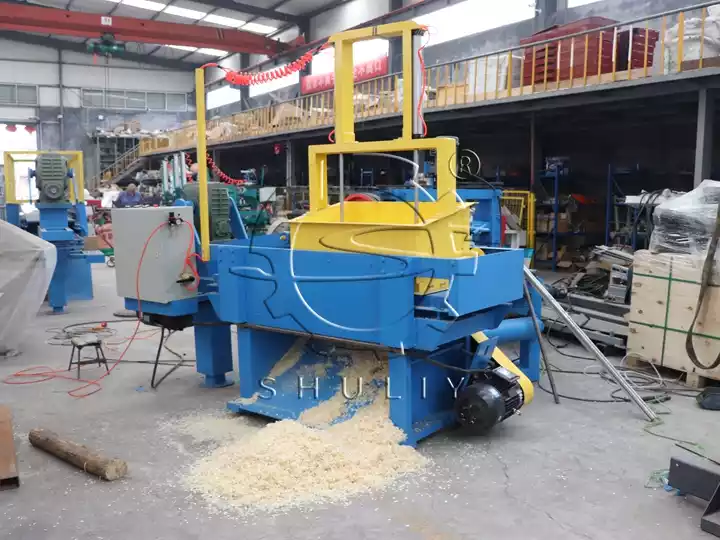
Horizontal wood shavers can process a variety of wood materials, including logs, branches, and scrap wood. Using a high-speed rotating blade assembly, they cut the wood into standard shavings approximately 0.2–2 mm thick. The finished product is highly uniform and has minimal moisture content, making it suitable for continuous production lines. It is widely used in furniture manufacturing, biomass fuel production, panel filling, and animal bedding.
The equipment is primarily divided into standard-shaft and spiral-shaft wood shavers, allowing for flexible selection based on raw material characteristics and production requirements. Production capacities range from 250 kg/h to 4,000 kg/h, meeting the needs of production scales ranging from small workshops to medium- and large-scale factories.
In terms of structural design, the horizontal feeding method combined with a closed cutting chamber ensures more stable feeding while effectively reducing vibration and the risk of material ejection. The spiral-shaft model offers superior synchronization between conveying and cutting, making it suitable for processing high-moisture or irregular wood materials.
Applications of the horizontal wood shaver
- Furniture manufacturing: as raw material for particleboard and MDF.
- Biomass energy industry: as raw material for fuel pellets and briquettes.
- Animal husbandry: as bedding for horses and poultry.
- Packaging and cushioning materials: as a partial substitute for foam fillers.
- Wood processing plants: for the reuse of scrap wood, improving resource utilization.
Sawdust shaving machine advantages and features
- Horizontal design: ensures smoother material feeding and is ideal for continuous processing of long workpieces.
- Dual-structure options (standard shaft/spiral shaft): adaptable to different wood shapes.
- High-strength cutter system: W18 high-speed steel blades with excellent wear resistance.
- Enclosed cutting chamber: reduces chip scatter and enhances safety.
- Adjustable shaving thickness: freely adjustable from 0.2 to 2 mm.
- Wide range of production capacities: meets needs from small-scale to industrial-scale operations.
Wood shaving machine operation and precautions
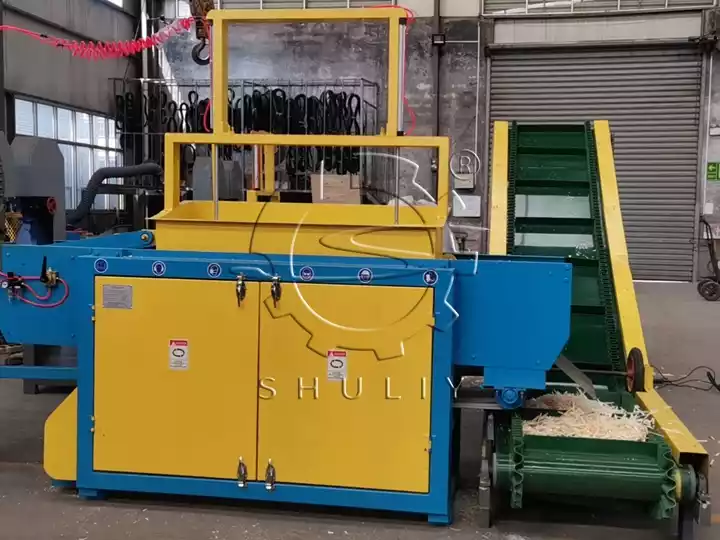
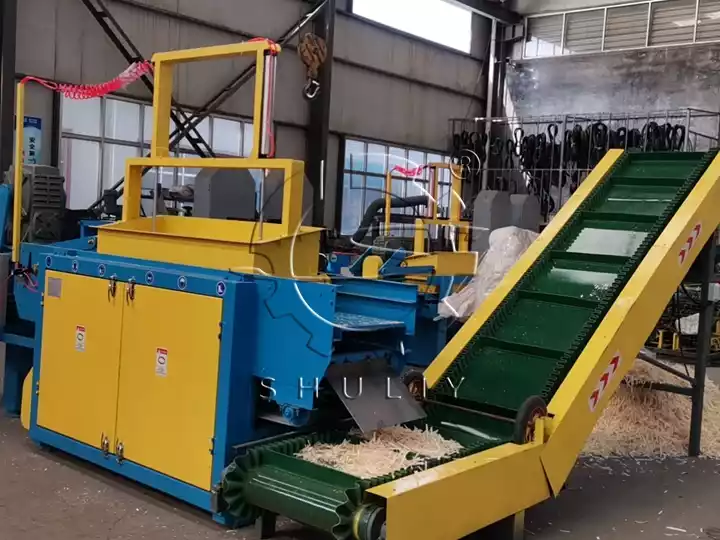
In a horizontal wood shaver machine, the motor drives the spindle to rotate at high speed, and the cutter head continuously planes the incoming wood within the cutting chamber.
Conventional shaft models rely on linear feeding to complete the cutting process. In contrast, spiral shaft models utilize a spiral feed mechanism to continuously advance the wood forward during rotation, achieving a more stable cutting rhythm.
Once the wood enters the cutting zone, it is uniformly sliced into thin shavings by high-speed blades. The shavings are then automatically discharged through the outlet, creating a continuous production process.
- Before starting the machine, inspect all fasteners and the condition of the blades.
- Startup sequence: Main motor first → Feed system second.
- Run the machine under no-load conditions to confirm there are no abnormalities before feeding material.
- Maintain a uniform feed rate to avoid overloading.
- Strictly prohibit hard objects such as metal or stones from entering the equipment.
- Maintain a safe distance during operation.
Animal bedding wood shaver technical specifications
| Model | SHBH500-1 | SHBH500-2 | SHBH500-4 | SHBH500-6 | SHBH1000-6 |
| Processing Length (mm) | 800 | 800 | 1400 | 1400 | 1800 |
| Processing Width (mm) | 500 | 500 | 500 | 500 | 1000 |
| Cutter Heads | 1 | 2 | 4 | 6 | 6 |
| Blades Quantity | 4 | 8 | 16 | 24 | 48 |
| Rotation Speed (r/min) | 3500 | 3500 | 3500 | 3500 | 3500 |
| Power (kW) | 7.7 | 10.5 | 21.25 | 28.75 | 50 |
| Output (kg/h) | 250 | 500 | 1000 | 1500 | 4000 |
| Shaving Thickness (mm) | 0.2–2 | 0.2–2 | 0.2–2 | 0.2–2 | 0.2–2 |
Horizontal wood shaver machine pricing information
The price of horizontal wood shavers is typically influenced by the following factors:
- Equipment model (500 Series / 1000 Series / Industrial-Grade).
- Structure type (Standard shaft / Helical shaft).
- Number of cutting heads and configuration level.
- Motor power and production capacity requirements.
- Whether equipped with an automatic feeding or dust collection system.
Generally speaking, smaller models are suitable for startup processing facilities, while high-output helical-shaft models are better suited for large-scale factory production lines.
How to choose the suitable wood shaving equipment?
When selecting a horizontal wood shaver machine, we recommend considering the following factors:
- Raw material type: for hardwood, we recommend choosing a spiral-shaft model.
- Production capacity requirements: for 250–1,000 kg/h, choose a small-to-medium-sized model; for 1,500 kg/h or more, choose an industrial model.
- Production continuity: for continuous production, prioritize spiral-shaft models.
- Site conditions: if space is limited, choose a compact standard-shaft model.
- Level of automation: determine whether integrated conveying and knife sharpening systems are required.
How to perform routine maintenance?
- Check the sharpness of the blades regularly and sharpen them as needed.
- Lubricate the bearings monthly; increase the frequency during continuous operation.
- Adjust the belt tension (a sag of 6–10 mm is ideal).
- Clean up debris and dust daily.
- Apply rust-preventative oil to metal parts during extended downtime.
- Check that the screw shaft and main shaft are running smoothly and without unusual noises.
Related equipment
- If you require a small-scale processing solution with higher precision, learn more about our compact wood shaving machine: Wood Shaving Machine For Animal Bedding.
- To enhance the efficiency of your automated production line, you can integrate this equipment with industrial wood chippers, wood shredders, and other machinery to create a complete production system.
Please select the model that best suits your actual production needs. We offer customized configuration solutions to help you achieve more efficient and cost-effective wood processing.